
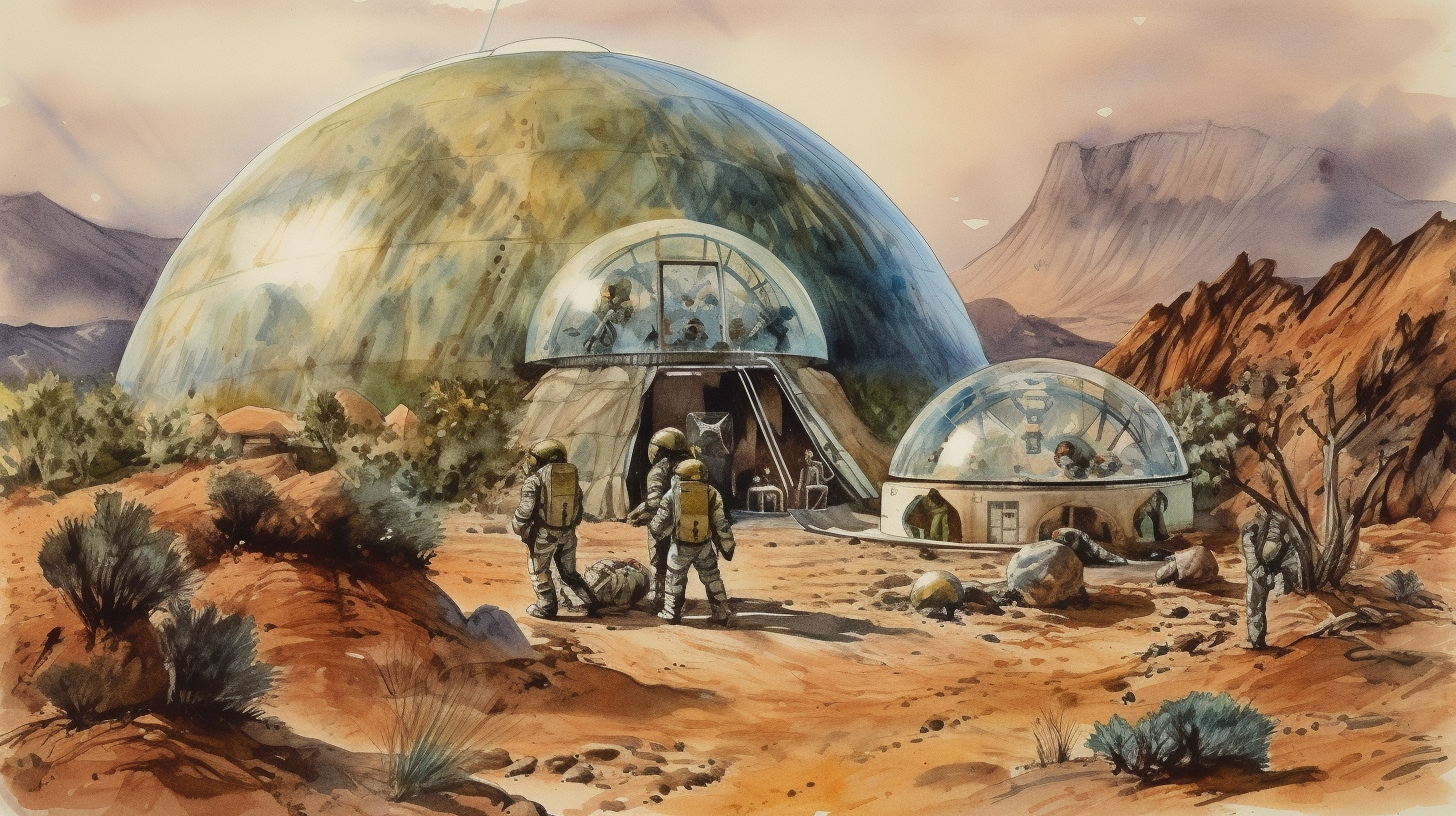
Maurizio Balistreri and Steven Umbrello engage in a critical exploration of the philosophical, ethical, and practical implications of human space travel and extraterrestrial colonization. The authors offer an in-depth analysis of two main strategies proposed in the literature: terraforming (geoengineering) and human bioenhancement. The first approach implies transforming extraterrestrial environments, such as Mars, to make them habitable for human life. The second approach involves modifying the human genetic heritage to make us more resilient and adaptable to non-terrestrial environments. The authors meticulously scrutinize these alternatives, considering not only feasibility and cost but also the ethical and philosophical implications.
The authors underscore the potential of terraforming as a method to establish human settlements on Mars. However, this possibility raises several ethical concerns, including the potential destruction of extraterrestrial life forms, the alteration of untouched landscapes, and the potential overstepping of human dominion. On the other hand, human bioenhancement, though a promising path, engenders its own set of ethical dilemmas. The authors caution against reckless enthusiasm for genetic modification, drawing attention to the potential creation of a new ‘human species’ and the consequent risk of divisions and misunderstandings.
A central theme in the article is the comparison of natural and artificial constructs. The authors challenge the assumption that the natural is always superior to the artificial. Drawing on posthumanist perspectives, they suggest that, given our influence on Earth’s environment, nature is already an artificial product. The argument is extended to other planets, indicating that the traditional dichotomy between the natural and the artificial may not hold in the context of extraterrestrial colonization.
The article contributes to broader philosophical discourses about the human relationship with nature and our place in the universe. It resonates with themes of transhumanism and posthumanism, contemplating the potential of technology to overcome human vulnerabilities and achieve a new evolutionary stage. The authors invite us to question and possibly redefine our notions of ‘natural’ and ‘artificial.’ This study, therefore, serves as a significant touchstone for futures studies, linking the practical considerations of space travel with philosophical reflections on human nature and our interaction with the environment.
For future research, the authors’ comparative analysis of terraforming and human bioenhancement opens several avenues. While the ethical implications of both strategies have been discussed, a more comprehensive ethical framework could be developed, perhaps drawing on principles of bioethics, environmental ethics, and space ethics. Additionally, the potential of hybrid approaches combining elements of both strategies could be explored. Lastly, given the increasing likelihood of extraterrestrial colonization, a more detailed analysis of the potential social, cultural, and psychological impacts on human populations in these new environments would be a valuable contribution.
Abstract
As space travel and intentions to colonise other planets are becoming the norm in public debate and scholarship, we must also confront the technical and survival challenges that emerge from these hostile environments. This paper aims to evaluate the various arguments proposed to meet the challenges of human space travel and extraterrestrial planetary colonisation. In particular, two primary solutions have been present in the literature as the most straightforward solutions to the rigours of extraterrestrial survival and flourishing: (1) geoengineering, where the environment is modified to become hospitable to its inhabitants, and (2) human (bio)enhancement where the genetic heritage of humans is modified to make them more resilient to the difficulties they may encounter as well as to permit them to thrive in non-terrestrial environments. Both positions have strong arguments supporting them but also severe philosophical and practical drawbacks when exposed to different circumstances. This paper aims to show that a principled stance where one position is accepted wholesale necessarily comes at the opportunity cost of the other where the other might be better suited, practically and morally. This paper concludes that case-by-case evaluations of the solutions to space travel and extraterrestrial colonisation are necessary to ensure moral congruency and the survival and flourishing of astronauts now and into the future.
Modifying the Environment or Human Nature? What is the Right Choice for Space Travel and Mars Colonisation?